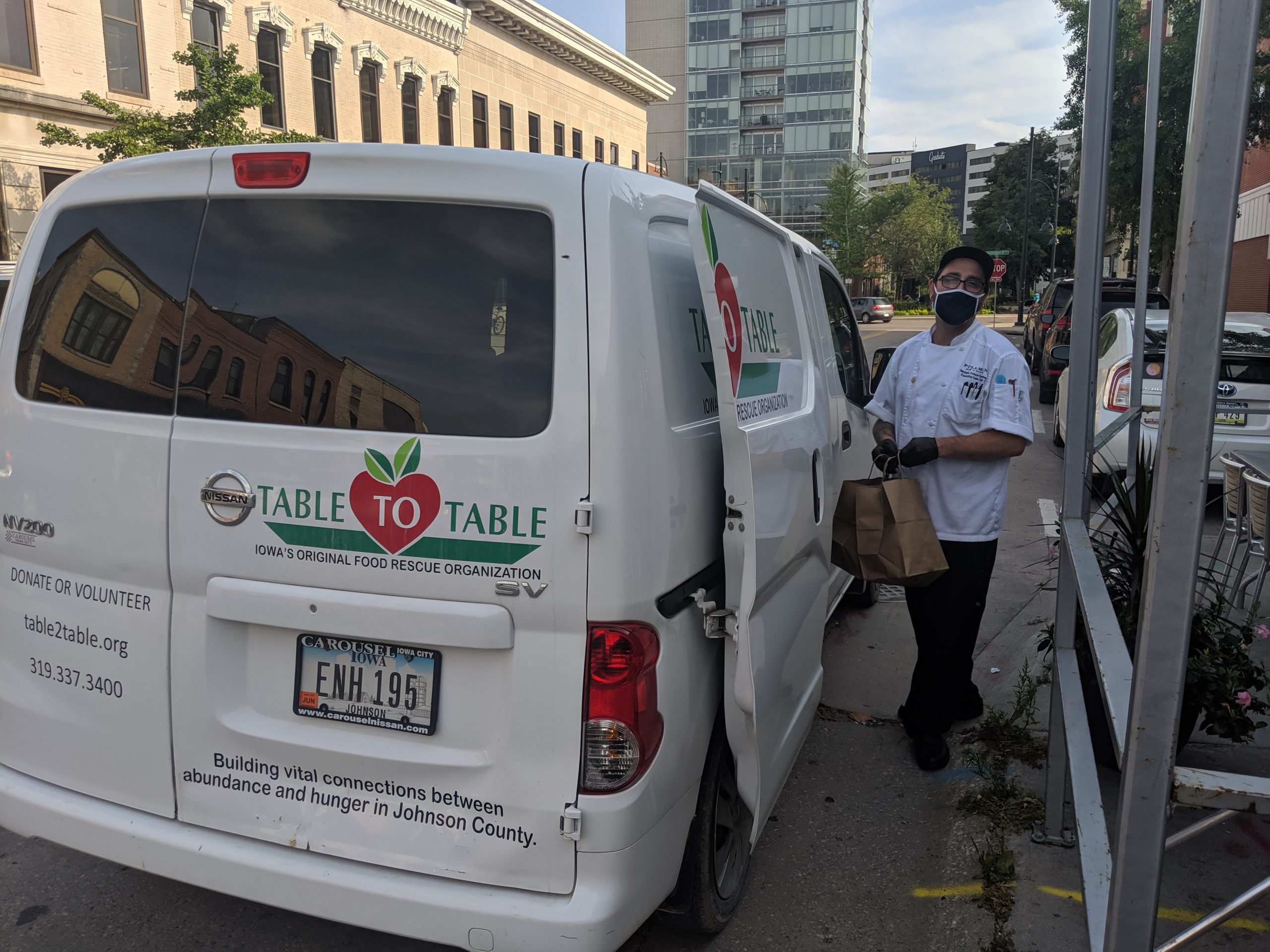
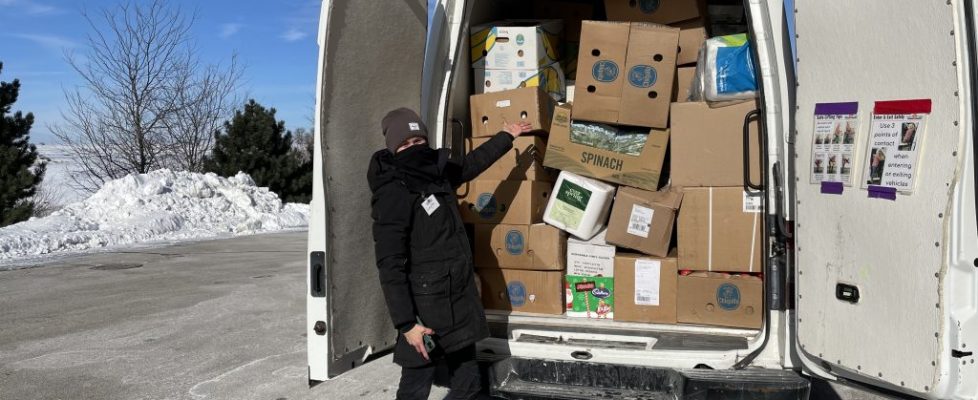
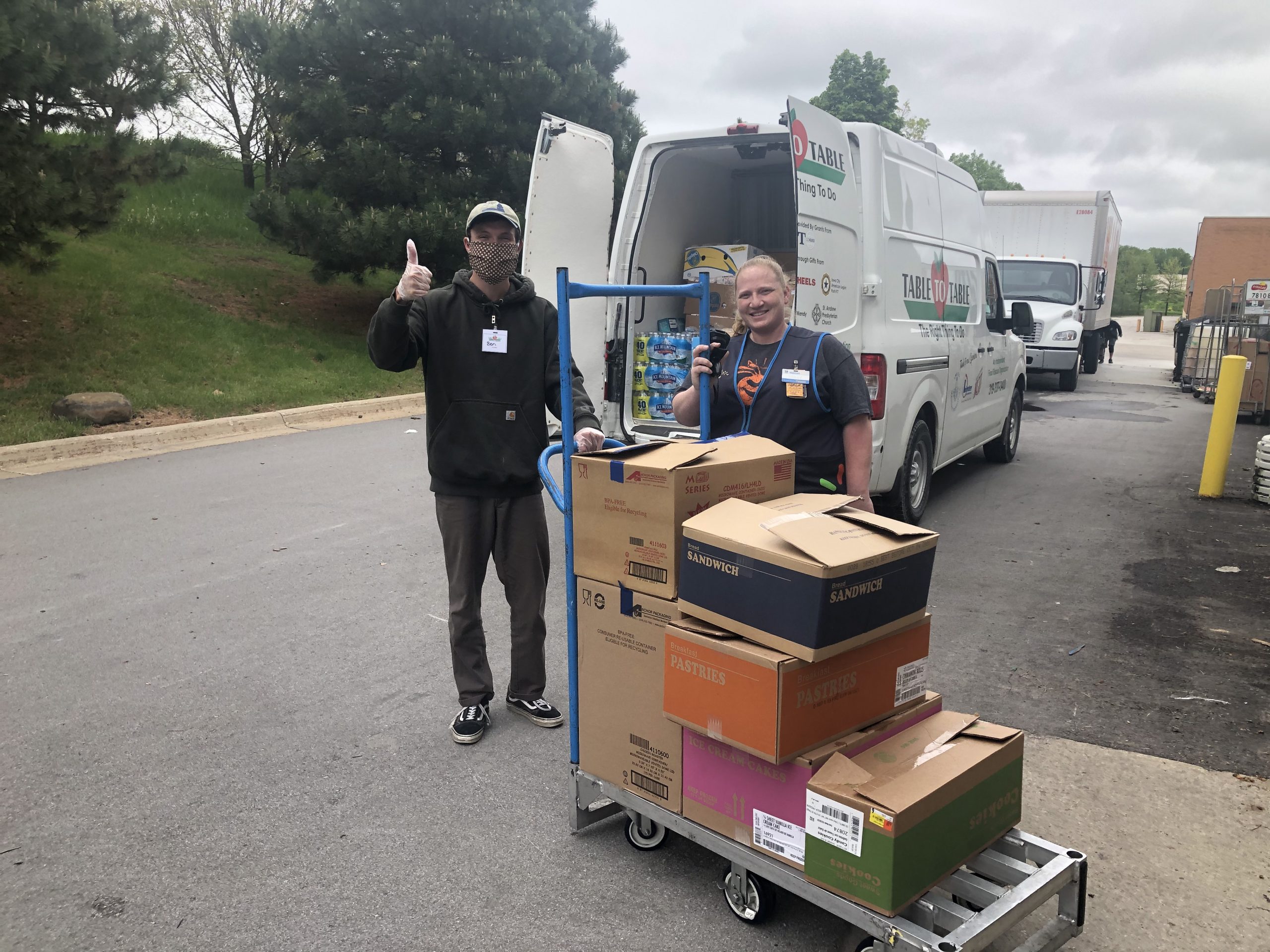
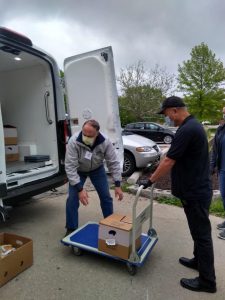
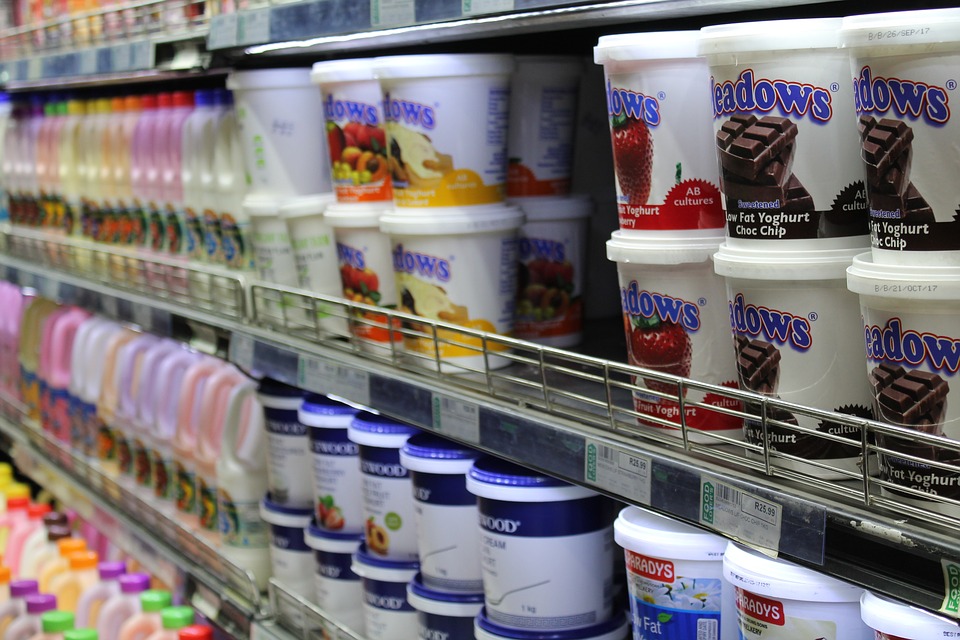
Table to Table’s Food Transportation Rescue program aims to capture good food that may go to waste as a result of being rejected by local food vendors. This can happen for any number of reasons and often has nothing to do with its quality – damaged packaging, mislabeled items, or simply too much of a product are all common reasons that vendors reject shipments even though it’s still perfectly good food. The past two years, T2T staff and volunteers have worked hard to develop this program, maintaining 17 partnerships with food transportation companies and warehouses, and successfully recovering nearly 140,000 lbs. of good food through rejected truckloads. To promote the program, AmeriCorps and volunteers designed and posted flyers in food warehouse porta potties, which has been our most successful outreach effort to date – call that creative marketing!!
Food Rescue Tales
In November we received 35,000 lbs. of distilled water that had been rejected due to 1 damaged jug. Not only can distilled water be drank, but it can be used for medical and cleaning purposes as well – a super unique offering that our partners were thrilled to receive!
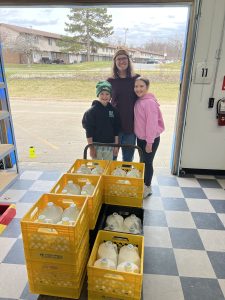
This March, we happily accepted a 2,030 lb. donation of milk that was rejected due to a few leaky cartons. Luckily, T2T Dispatcher Ryan Mohwinkle recruited their visiting siblings to help us clean off each carton and distribute them to our partners!
Iowa City, Iowa, March 20, 2023 – Table to Table (T2T), a volunteer-based Iowa City non-profit organization that recovers and delivers half the food distributed to people facing food insecurity in Johnson County has had services disrupted after theft of catalytic converters from their food rescue vehicles.
Upon arriving at T2T to launch food rescue routes this past Friday morning, T2T staff and volunteers discovered two vehicles were completely disabled, missing their catalytic converters. This pricey part has been the target of a nationwide rash of thefts. While this stolen part may get thieves only $50 to $300 at a scrapyard, this small nonprofit will have to pay $1,500 to $3,000 to repair and replace the parts, and then even more to protect these vehicles and the others from future catalytic converter theft.
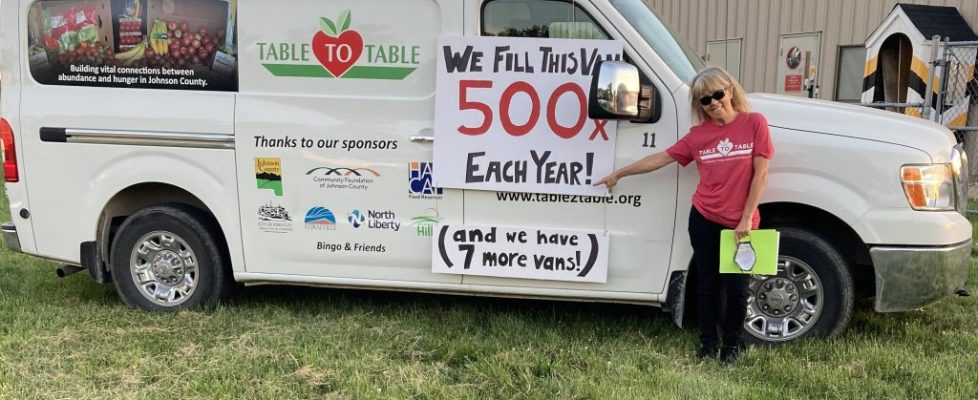
With just a small fleet of refrigerated cargo vans, T2T volunteers collect and redistribute 45,000 pounds of food each week in Johnson County. This is a critical lifeline local neighbors need now more than ever due to drastic reductions in SNAP benefits enacted in April of 2022, and a dramatic increase in food prices that have led to a rapidly changing (increasing) food insecurity landscape in Johnson County. As resources at T2T’s local partner organizations including local food pantries and emergency meal sites are stretched thinner and thinner, every pound of food T2T can deliver is critical. Due to these thefts, T2T is currently operating without a quarter of their regular fleet, making it harder to capture all the food available as long as the vehicles are out of commission.
T2T needs community support to get the vehicles back on the road and bring operations back up to full capacity. Costs estimated for the affected vehicles exceed $5,000 and estimates to protect their remaining vehicles is not yet known. To donate, please visit table2table.org/donation
####
Table to Table is a Johnson County non-profit that bridges the gap between abundance and hunger. Table to Table volunteers keep wholesome, edible food from going to waste by collecting it from local food donor organizations and distributing it to local anti-hunger organizations. T2T has distributed well over 30 million pounds of food locally since its founding in 1996.
Table to Table’s route-based food rescue is a unique model that matches food donations directly to recipients during each three-hour route. In traditional models, the food is brought back to a warehouse where recipient partners place an order and pick it up later in the week. Or these partners pick up food donations directly from a store, using their own resources, and all donations from a store go to a single recipient agency. Sometimes it’s not enough food and sometimes it’s more of one item than a single agency is able to use.
Route-based rescue matches the right amount of food to the right partners immediately. The benefits of this model are many; it reduces waste by getting food to tables more quickly, allows partners to choose what fits their needs, and increases variety for the entire system. Food rescue efforts in similarly-sized communities using other models are usually unable to reach the efficiency or food donation totals that we experience here in Johnson County. Our daily delivery schedule increases food donations and allows recipient agencies to refill their limited storage repeatedly during the week.
In our early years, consolidating local food rescue to Table to Table wasn’t easy. “It took convincing,” says David Wellendorf, T2T Volunteer & Transportation Manager from 2002-2017. “You needed to convince the donor and recipient that this will work while looking at your logistic means to make sure you don’t oversell your ability…It’s a big puzzle.”
We asked David, how did you do it, in the beginning?
“Tenaciousness.” That’s how it happened, he says. “And we loved it.”
David, what kept you engaged and loving the work?
“The volunteers—Are you kidding? The passion of each person coming in and saying, ‘I want to make a difference.”
T2T food rescue route volunteer Al Stang loads food donations into the T2T vehicle in 2015.
The volunteer route-based model is essential to food rescue success. This year, volunteers provided over 20,000 hours of service at Table to Table.
Developing and maintaining a stable workforce of volunteers is critical to the success of the T2T operation.
As David says of those early years, “Logistically we could’ve set the world on fire, but our logistical abilities outpaced the money we could bring in.” Volunteers were critical, but by 2016 not having enough staff or space to manage those complicated logistics was holding the organization back. That year, T2T recovered nearly two million pounds of food with three staff in a 700-sq. ft. basement office — a truly remarkable feat, but unsustainable.
Fortunately, T2T had proven that this crazy idea could work, and with the support of our community grew our resources to make large scale food rescue sustainable. In 2002, T2T was running two routes each day. Now, we run about 45 routes a week. How? With the same community dedication and partnerships that launched Table to Table 25 years ago–only now with six staff, 100+ food donor partners, 50 recipient partners, and 150+ regular volunteers.
Currently each week, T2T picks up thousands of pounds of surplus food from local warehouses, UNFI and US Foods. Now accounting for 31% of the food we rescue, this food isn’t even short-dated and serves as a source for more organic, gluten-free, and vegetarian foods.
Getting this program up and running didn’t happen on its own. Picking food up at this scale would require several trips in our smaller transit vans, so in the early days, John’s Crane let T2T use a 16-ft. truck weekly for free. When T2T outgrew that truck, we moved to renting a large truck twice a week to pick up warehouse donations.
In 2017, staff David Wellendorf and Emily Meister developed a partnership and with a significant donation from Frontier Natural Products were able to lease a dedicated 22-ft. refrigerated truck. Since then, this truck has made more than 350 trips transporting nearly three million pounds of food.
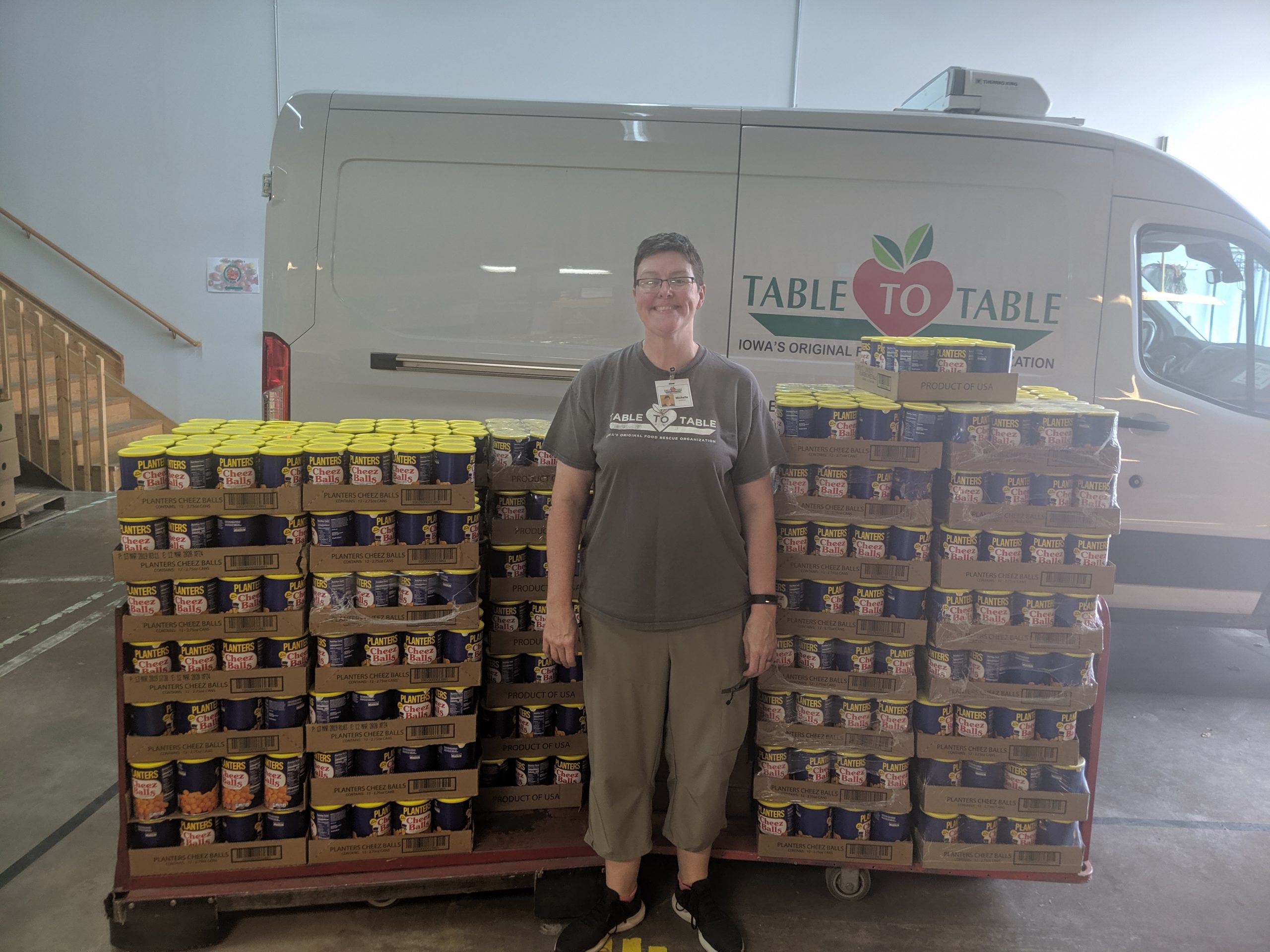
Michelle after a route last year that collected hundreds of cans of cheeseballs.
As we wrap up volunteer appreciation month, we can’t think of a better way to express our appreciation for our fantastic volunteers than by sharing stories from their T2T volunteer shifts in April. These stories illustrate volunteers’ resourcefulness, good humor, and enthusiasm to go above and beyond in the name of food rescue. We truly could not recover nearly 2.5 million pounds of food each year without them.
Just last weekend, volunteer Michelle Hills finished her regular food rescue route collecting a few hundred pounds of food. While she was out, another volunteer called in and couldn’t do their route. Michelle noticed when she got back from her regular route that nobody had recorded any donations for that route and offered to do that one too! Without her, we may have lost the opportunity to deliver more produce, meat, and a variety of other foods to Coralville Community Pantry that morning.
————————
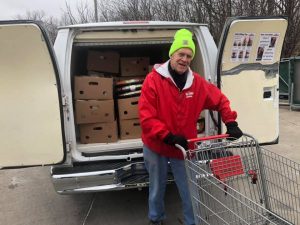
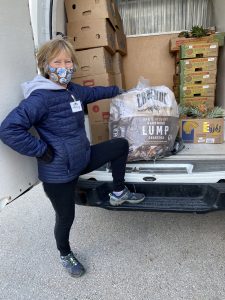
Nancy pulls a cart full of food ready to load
Mary Palmberg and Nancy Weber picked up a huge haul at Walmart & Costco a couple of weeks ago. Mary says, “No surprise that we barely — and only due to our years of practice — fit all that frozen bakery and (heavy) frozen meat into the cooler section [of the van].” On top of that, they received lots of whole pineapples.
All loaded and charcoal briquettes to boot!
At the next stop, a couple of hundred pounds of charcoal briquettes! So, upon delivery, Mary made a deal: “We told Hải at the Coralville Pantry that she could have some of those nice pineapples if she took some charcoal briquettes…the number of pineapples dependent on the number of 20# bags of charcoal. She laughed — though she also took charcoal along with her pineapples.”
The good-natured flexibility of our partners to accept whatever crazy variety of food (and BBQ accouterments) that arrive on the truck is key to our success. “We were amazed that we’d passed off all the charcoal — and everything else — by the end of the route,” Mary says.
We’re impressed by the packing and sorting skills our veteran volunteers have. It’s an underrated talent that ensures no fruit is left behind!
————————–
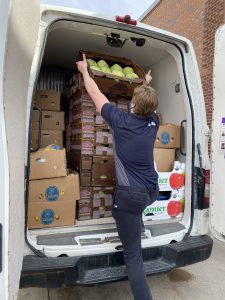
The staff help stack the second tower of cabbage into the van.
On another of what Mary calls an “exciting & rewarding day on the road”, it was looking like a “light” food rescue day with two carts of grocery, meat, and bakery…until a very helpful and friendly store employee, Taveon, led the team back to a cooler with towers of cabbage and bananas. So many, it warranted a call back to base to see if T2T had the capacity. After getting the affirmative, they had to do their magic again to fit everything in the van. On their way out, Mary asked about a cart of miscellaneous items including toys and Easter baskets that weren’t for sale anymore, so they took those too! Hải Huỳnh, Coralville Pantry Community Projects Coordinator, shared with the volunteers that those extra toys and gifts they asked for would be put in birthday bags for kids.
Mary and Nancy made stops at North Liberty Pantry and HACAP Head Start and then an additional stop at Shelter House where they delivered a box of bananas and quite a few cabbages. The cook was excited about preparing the cabbages for dinner that evening.
T2T recipient partners and our volunteers are truly remarkable, and it’s clear that the admiration is mutual. Mary and Nancy return from their route celebrating their interactions with Hải: “What a super (& strong!) woman she is!” and, “She’s fantastic!”
————————–
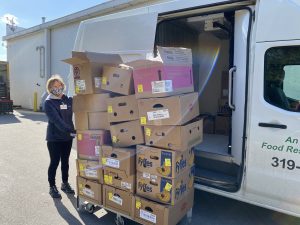
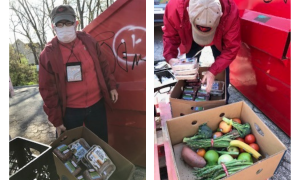
Kenn packs healthy prepared foods into our boxes.
Kenn & Pat Bowen, volunteers since this past September, shared photos of their beautiful haul from New Pioneer Coop. Fresh veggies and healthy prepared foods were a welcome and delightful delivery that day!
——————–
And finally, volunteer Charlotte Fairlie passed along an impactful message she received from a community member as she was picking up food at a stop on her route just a few days ago:
“A woman rolled down her window as she was pulling out of her parking space and said,
‘I just want to thank all of you for everything you are doing and all the work you put in. I have been in the position of having to use your services, and I want you to know how valuable it is and how much it’s appreciated.’”
As Charlotte says, “Her message is for all of us.”
Route volunteer Claire drops food of at the Salvation Army.
Table to Table has kept 22 million pounds of food from going to waste since April 1996. As Iowa’s original food rescue organization, our unique food rescue model maximizes the amount of food we can rescue and gets it to people who can use it quickly. Route-based rescue allows us to ensure maximum amounts of food are used by our partners before it goes to waste. In fact, our partners report that most of the perishable food we collect each day is distributed to a family who can use it within six hours of our delivery. But what do we mean when we say “route-based rescue”?
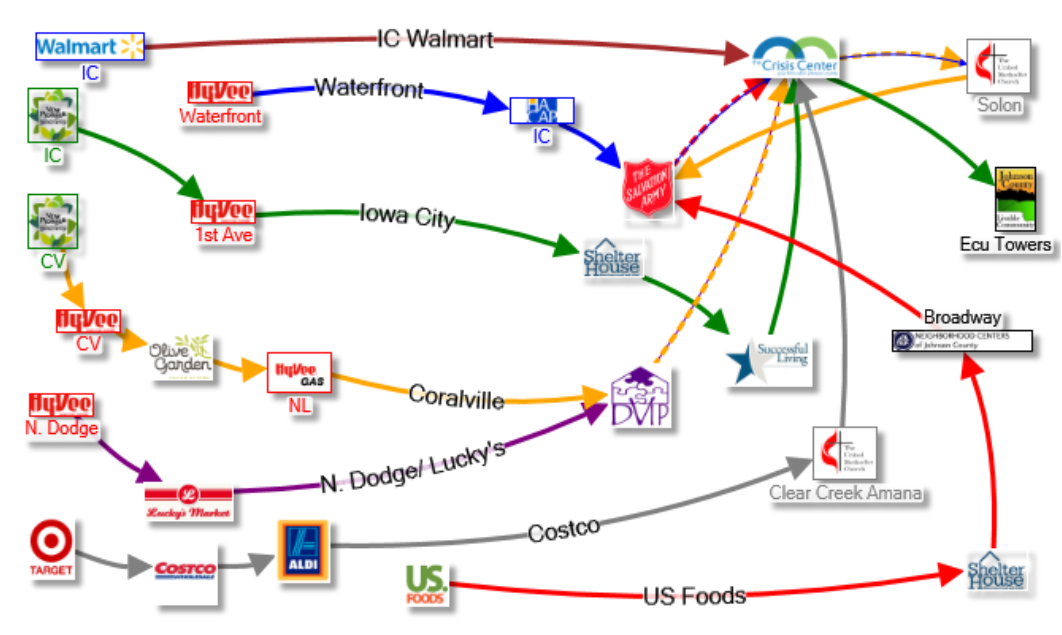
Well, it looks like this!
Just a normal Thursday route diagram.
It’s nearly as complicated to implement as it looks. The good news is, our program staff are experts and our partners are committed and that’s what it takes to make this work.
A Single Route
To put it simply, this is what a single route looks like on any given day. We do this 8-10 times per day!
Each day, volunteers hop in a Table to Table van and drive to a few of our food donor partners. They load the van with produce, dairy products, meat, bread, pizzas, pre-made chicken wraps — you name it! They then drive to a few of our recipient partners, who select what foods they’ll need that day from the T2T van.
The benefits of route-based rescue:
T2T Route Volunteer Ben picks up food donations at one of our food donor partner sites.
More food from donors. Volunteers follow a specific route at the same time each day to ensure that our donor partners know when they’re coming and have food donations ready for them. They can easily determine whether the food they have will still be good by the time Table to Table will arrive.
Recipients can plan for food deliveries. Our recipient partners know when to expect their food deliveries for that day and have some consistency in what we’ll deliver. When the Coralville Pantry knows we’ll deliver 50 gallons of milk from the Kalona Creamery on Thursday afternoon, they know they won’t have to buy any to meet the need of their pantry members.
Maximum matching of donations to recipient partners. T2T volunteers can become experts at their route. They serve as daily ambassadors to collect feedback about what donors will give and what recipients can take. Our program staff uses this information to make adjustments.
T2T volunteers drop food off at IC Compassion, one of our food recipient partner organizations.
Rapid delivery of short-dated foods.We don’t bring food back to T2T for storage. Volunteers are transporting food directly from the donor to the recipient using a temperature-controlled van in a matter of hours. The produce that’s picked up this morning will be in a family’s refrigerator by this afternoon. Each month on average we collect 100,000 pounds of fresh produce, meat, and dairy products.
Valuable food free to our partners! Many recipient agencies have no other source for these fresh foods, and certainly not another free source. Good food. Free food. It’s a win-win.
Thanks to our route-based model, we are able to rescue more than 2 million pounds of food annually in Johnson County, and our partners make sure it gets to those who need it. Without our route-based rescue, much more of this food would go to waste, never making it to the community and to family tables.
The impact of our grant from Frontier Co-op to purchase a new refrigerated vehicle and one year lease on our refrigerated “big truck” can be best illustrated by the “Great Yogurt Boon of 2017”. On a Wednesday in mid-September we received a call that a local food warehouse had 8 pallets, nearly 9000 pounds of yogurt to donate. Nine thousand pounds of yogurt and the expiration was more than a month away! What a windfall! In fact, dairy is one of the most needed items for agencies serving the hungry in our community.
However, 4 tons of dairy that needs to be refrigerated presents its own challenges. Since no single partner agency can store or redistribute food in those quantities, we needed a storage and distribution plan. With our two new vehicles, we were able to accommodate this challenge with little difficulty. Our new 22ft refrigerated had the capacity to transport and keep cool all 8 pallets. We were able to use the truck as a temporary warehouse and work over the course of several hours to distribute this high value food to more than 15 local programs.
Even so, at the end of the day, we still had 800 pounds of yogurt remaining, which was not likely to fit in the 7 household sized refrigerators we have back at Table to Table. So, we transferred the remaining yogurt to the new transit van we purchased with the help of Frontier Co-op. We can actually plug this new vehicle’s refrigeration system into a wall outlet, thereby expanding our refrigerated warehouse space to 350 cubic feet. By storing the yogurt for the next 36 hours, we were able to find additional recipients in need of dairy. Local after school programs received more than 50 cases to serve as snacks and small pantries with minimal storage capacity received a second delivery after distributing the first load of yogurt early in the week.
These organizations served around 3,000 individuals with this single delivery. Without these new vehicles, this nutritious and high need food would have either gone to waste or been diverted away from those in need right here in our community. Thank you to Frontier for helping keep good food from going to waste and feeding 19,500 hungry people.
Table to Table is a 501(C)3 non-profit organization (EIN 42-1457219)

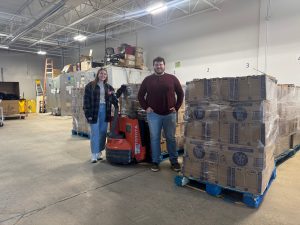 In November we received 35,000 lbs. of distilled water that had been rejected due to 1 damaged jug. Not only can distilled water be drank, but it can be used for medical and cleaning purposes as well – a super unique offering that our partners were thrilled to receive!